


Buying a new condominium is exciting—but beyond floor plans and PSF, your daily experience and long-term costs hinge on how the estate is governed, funded, and maintained after TOP. That’s the blind spot for many purchasers.
For new condo buyers Singapore, this guide sets out six essential due-diligence checks: review MCST minutes and by-laws, assess the sinking fund vs. management fund, verify current maintenance fees and their trend, and evaluate developer/contractor quality.
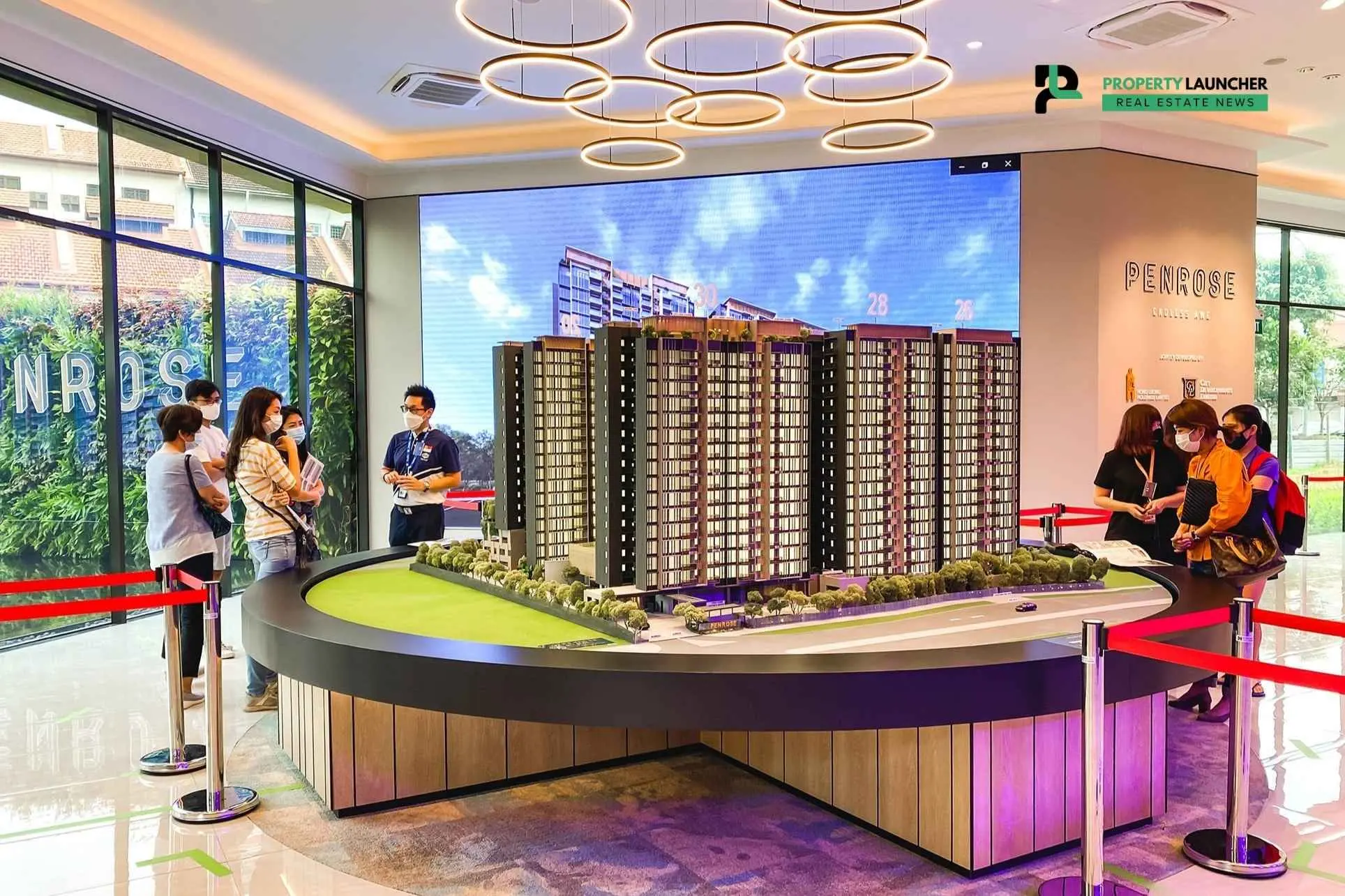
Do these before committing to minimise the risk of special levies, unexpected fee increases, and ongoing estate-management issues.
The 6 Checks Buyers Skip (Pre-OTP)
1) Understand what the MCST actually does – plus your voting power
Your Management Corporation Strata Title (MCST) runs the estate: budgets, by-laws, tenders, security, defects escalation, and more. Day to day, it’s supported by a Managing Agent (MA), but owners vote at AGMs to approve budgets, appoint council members, and authorise major expenses.
What to verify before buying
| Managing Agent (MA) | Who is the MA? Established firm? How long have they served this estate? Any recent tender/renewal? | Experience and continuity drive day-to-day standards and response time. |
| Accreditation | Is the MA/council aligned with recognised bodies (e.g., APFM, ASM)? Any certifications for key staff? | Baseline professional standards and complaints handling. |
| Council stability | Any frequent council turnover or MA changes in the last 2–3 years? Any AGM disputes recorded? | High churn often signals governance friction and inconsistent policies. |
| By-laws to note | Renovation hours/permits, balcony use (drying, BBQ), pets policy, short-stay rules, common-area usage. Any recent changes? | Direct impact on lifestyle, rental strategy, and compliance risk. |
Quick table: who does what
| Body | Role | Why buyers should care |
| MCST Council | Elected owners set policies, approve spend | Determines fee discipline & estate priorities |
| Managing Agent | Runs daily ops, supervises vendors | Direct impact on cleanliness, security, response time |
| Owners (you) | Vote at AGMs/EGMs | Your leverage to keep fees sensible & works timely |
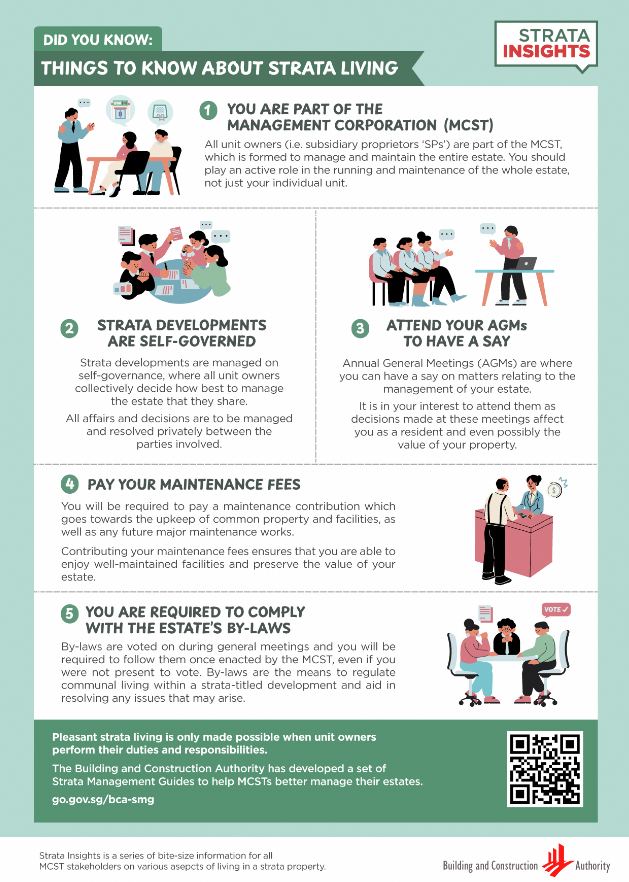
2) Read the sinking fund (not just the brochure)
Condo financials have two buckets:
| Fund | Purpose | Pays for | Examples |
|---|---|---|---|
| Management fund | Day-to-day operating costs | Recurring expenses | Cleaning, security guards, landscaping, utility bills, routine repairs, minor supplies |
| Sinking fund | Long-term capital works | Big-ticket, long-life items | Estate repainting, lift overhauls/replacement, waterproofing, façade repair, major M&E upgrades |
A thin sinking fund—especially in estates >5 years old—often precedes special levies (one-off top-ups from owners). Don’t rely on a seller’s anecdote; ask for the latest audited statements or AGM minutes and skim the balance sheet.
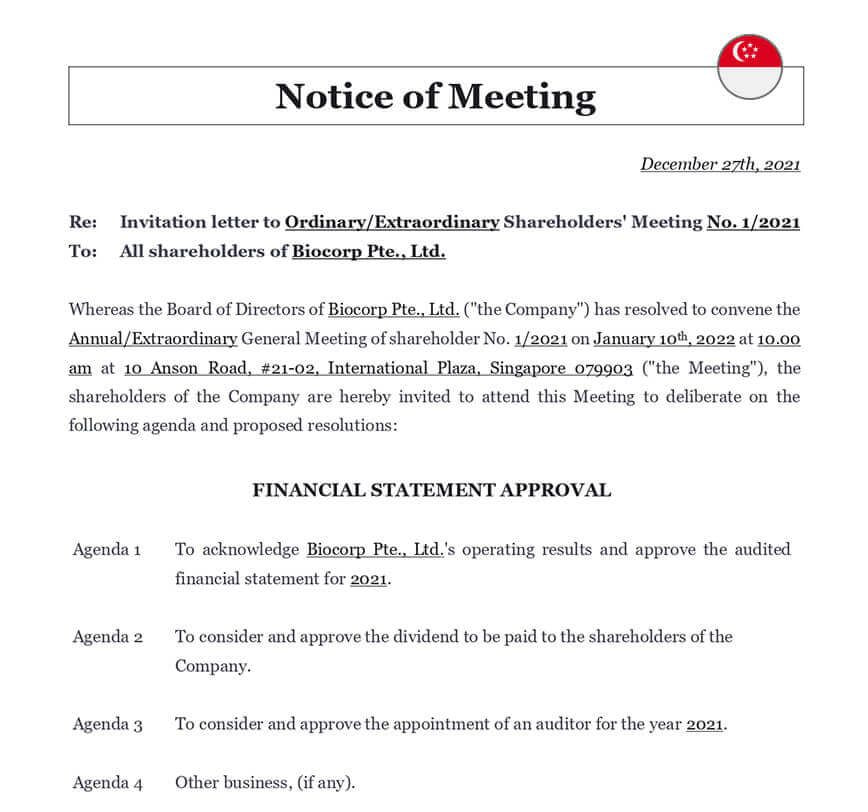
Notice of Meeting
What “healthy” looks like (rule-of-thumb indicators)
| Indicator | Healthy signal / what to see |
|---|---|
| Sinking fund trend | Balance builds over time; not flat-lining year after year |
| Planned major works | Big items (e.g., repainting in ~2 years) already budgeted or phased |
| Arrears (overdue fees) | Arrears are actively managed and not ballooning |
3) Compare projected vs actual maintenance fees
Brochures at launch often show estimated maintenance; after TOP, actual fees can be higher because real utility usage, security headcount, and defect rectification logistics replace assumptions.
What to do
- Get the latest fee schedule by unit share value (1BR vs 3BR may differ a lot).
- Check trend: have fees jumped in the past 1–3 years? Why?
- Cross-check with estate size & facilities: huge landscapes, multiple pools, or full-glass façades tend to cost more to maintain.
Signals of fee pressure
| Signal | Why it matters |
| High common-area utilities | Pools, water features, extensive façade lighting |
| 24/7 multi-gate security | More guards/shifts → higher manpower costs |
| Large landscaped grounds | Upkeep contracts add up; pest control too |
| Frequent lift/equipment faults | Recurrent repairs often precede replacement cycles |
4) Check developer & builder quality (objective scores help)
Defect volume and workmanship quality materially affect post-TOP costs and resident sentiment. Use quality/banding portals and industry benchmarks for a data-anchored view of the developer and main contractor’s track record the workflow shown here (digitised site data → document audits → data-driven BCA inspections, including virtual/tech-enabled checks) is exactly the kind of verifiable trail you want to see.
What to pull
- Past projects’ quality scores/banding.
- Defects close-out timelines reported by owners.
- Recurring patterns: façade/waterproofing issues, chronic M&E snags, lift reliability.
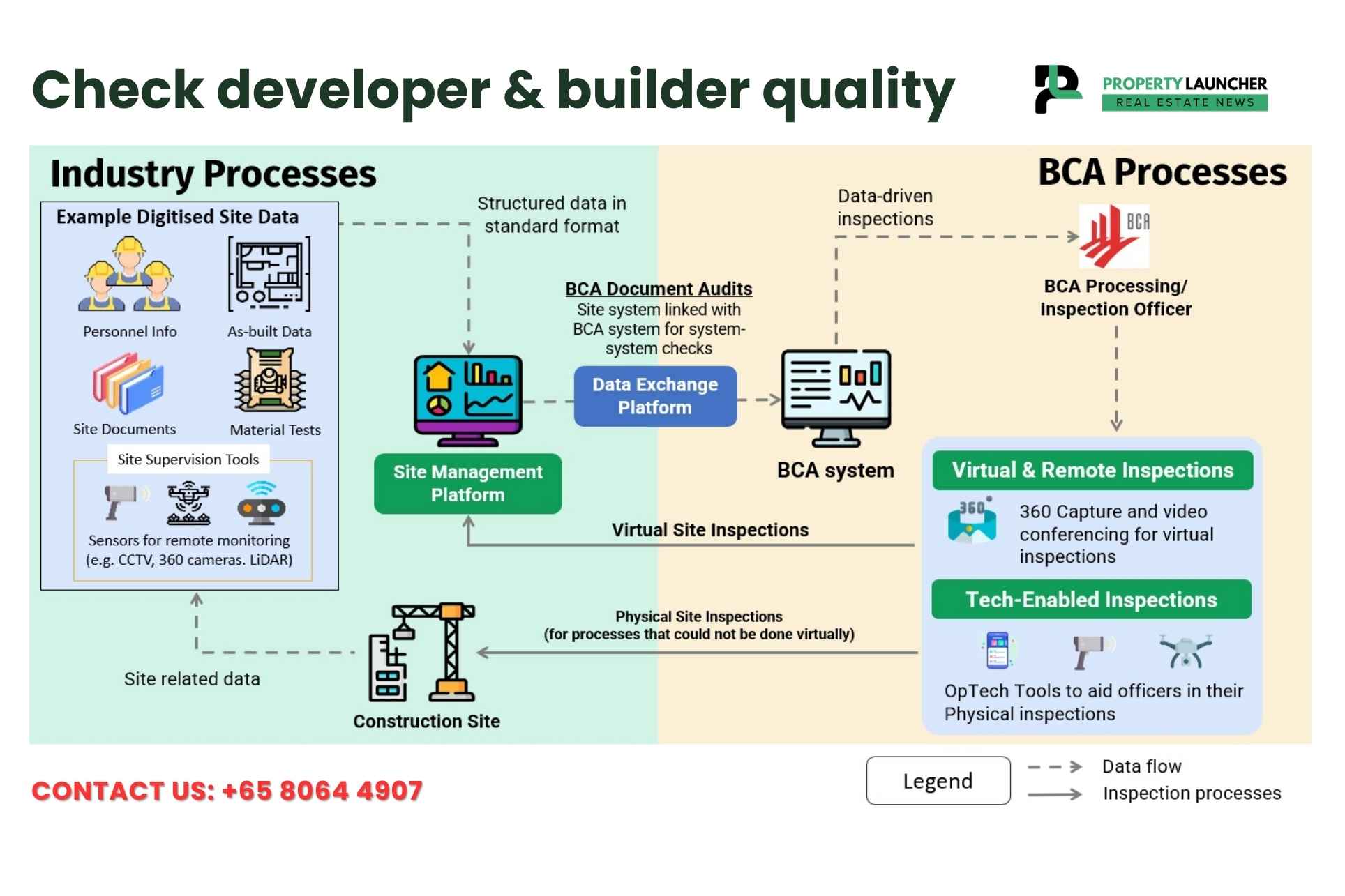
Pair this with quick on-site observations (if TOP): check sealants, tile alignment, corridor finishes, plant rooms—to confirm the paper trail and inspection workflow are reflected in real-world build quality.
5) Inspect facilities — and how residents actually use them
A polished showflat tells you little about operational reality. Visit the estate when it’s “alive” (weeknights 6–9 pm or weekends) and watch how people, vehicles, and vendors interact with the space. Bring a short checklist, take photos, and time a full circuit (carpark → lift lobbies → facilities → blocks → exits).
How to do the visit
| Timing | One weekday evening and one weekend afternoon, if possible. |
| Path | Guardhouse → drop-off → lobby → lifts → corridors → pool/gym → landscaping → bin points → carpark → side gates. |
| Ask quietly | Check with security/cleaners about peak hours, defect hotspots, and recent incidents. |
| Cross-check | Compare notice-board items with what you observe (e.g., repeated breakdowns, pest-treatment schedules). |
On-site heuristic checklist
| Security & access | Gates open/close smoothly; QR/visitor registration enforced; patrol frequency posted; CCTV coverage at entrances and lift lobbies; side gates not left propped open. | Lax controls raise liability, crime risk, and insurance requirements—costs and resident sentiment suffer. |
| Pool & gym | Water clarity (no cloudiness/foam), balanced chemical smell (not overpowering), tiles/grates intact, anti-slip surfaces, lifesaving gear present; gym equipment wiped, belts/cables not frayed, clear towel/sanitise rules. | Indicates contract discipline and preventive maintenance; poor hygiene and broken tiles lead to injuries and higher rectification costs. |
| Landscaping & drains | Weeds, algae, standing water; proper slope to drains; working pond aeration; trimmed trees (no branch drop risk); pest-control bait stations dated. | Stagnant water breeds mosquitos; neglected greenery snowballs into heavy contracts and town council fines. |
| Common toilets | Dry floors, working dispensers, no ammonia smell, intact fittings; cleaning schedule signed with timestamps; exhaust fans running. | Best proxy for the managing agent’s routine discipline. |
| Lifts & lobbies | Wait time during peak (≤90 seconds typical for mid-rise), ride smoothness, door sensors responsive, recent servicing log displayed; lobby ventilation and lighting adequate. | Frequent faults point to under-servicing; lift reliability drives resident satisfaction and insurance risk. |
| Corridors & finishes | Even tile alignment, intact sealants at skirting/expansion joints, paint touch-ups consistent, no water stains on ceilings; fire doors close automatically. | Micro-defects reveal workmanship quality and whether defects are closed properly or just patched. |
| Delivery & ride-hailing flow | Clear wayfinding; loading/ride-hailing bay not blocking fire engine access; no double-parking; guards guide drivers; parcels stored securely. | Poor flow breeds conflict and damages surfaces; repeated traffic chaos often triggers rule changes and more manpower costs. |
| Signage & notice boards | Readable, current notices (meeting minutes, pest treatment, lift servicing, incidents); not overcrowded; no aggressive warning tone; recurring breakdown posters. | A pattern of “urgent” notices or repeat faults suggests chronic issues and budget strain. |
| Waste & bin points | Odour control, lids closed, recycling not contaminated, chute rooms clean, scheduled collection posted; no rodent droppings. | Hygiene and vector control issues escalate quickly and attract penalties. |
| Carpark & lighting | Even lighting (lux levels consistent), clear lot markings, wheel stops intact, no ponding; ventilation fans working in basement; EV chargers maintained. | Safety & air quality; poor drainage leads to concrete spalling and higher capex later. |
| Acoustics & neighbours | Stand near pool/BBQ and below a typical stack; listen for equipment hum, pump vibration, traffic/expressway roar; check quiet hours posted. | Noise complaints are hard to fix and drive friction with management. |
Quick scoring rubric (optional)
- 2 = Good: Clean, functioning, documented schedules, staff present.
- 1 = Borderline: Minor defects, occasional backlog, inconsistent rules.
- 0 = Poor: Repeated breakdowns, hygiene lapses, safety risks.
Score each area 0–2; ≤10 total suggests higher management friction and future fee pressure.
If you observe repeated neglect (dirty toilets, recurring lift notices, stagnant water, unsecured access), budget higher maintenance fees and expect more rule enforcement and resident-management conflict.
If the estate runs smoothly at peak with visible schedules, responsive staff, and tidy facilities, that’s a strong indicator of disciplined managing-agent operations and healthier cost control.
6) Assess the resident mix & community culture
Unit mix influences behaviour and cost pressures:
- Shoebox/1BR heavy: more landlords & short-stay tenants → higher wear on facilities, delivery traffic, security load.
- Family-sized heavy (3–4BR): more owner-occupiers → steadier councils, longer-term decisions, often neater common areas.
- Mega-estates (1,000+ units): economies of scale for contracts but busier facilities; boutique sites inverse.

Scan the mailroom/parcel area, car-park labels, and notice boards; they reveal whether the estate skews investor or family-centric—and how rules are enforced.
Red Flags That Mean “Slow Down”
| Red flag | What it signals | What to do next |
|---|---|---|
| Very low sinking fund (vs estate age/size) | High chance of special levy soon | Ask for audited financials; model levy buffer |
| Back-to-back MA changes / dispute-heavy minutes | Governance friction; weak ops | Speak to MA; review past AGM resolutions |
| Repeated equipment failures (lifts, pumps) | Deferred capex; rising maintenance | Check repair logs; ask about replacement plan |
| Legal tussles / stalled rectifications | Contractor issues; cost overruns | Request correspondence summary; timeline/penalties |
| Large planned works w/ no funding plan | Fees/levy spike likely | Confirm tender, budget source, and schedule |
One or two issues may be manageable; a cluster is your cue to walk or re-price your offer.
How To Get The Documents (Fast)
You don’t need to own a unit to see basics. Here’s a practical sequence you can run with your agent:
- Ask the seller/agent for the latest AGM minutes and audited financials (most owners keep soft copies).
- If they’re slow, request at least the maintenance fee schedule, by-laws, and MA details first.
- For projects post-TOP, ask for any Defect Liability Period summaries and estate notices relating to rectifications.
- Cross-check developer/contractor quality banding via official portals.
- If still unclear, speak to the MA office politely as a prospective buyer—many will confirm non-sensitive facts.
What to scan first in minutes/financials
- Arrears & receivables (collection efficiency).
- Sinking fund movement (growth vs withdrawals).
- Tenders & contract renewals (cleaning/security costs).
- Planned major works & timelines.
- By-law changes that affect use/renovations.
Boutique vs Mega Condos: Which Suits You?
| Type | Pros | Cons | Best for |
| Boutique (≤200 units) | Quieter, more exclusive; fewer queues | Less scale for contracts → potentially higher per-unit fees; fewer facility options | Owner-occupiers who value privacy |
| Mid-size (200–700) | Balanced facilities & fees; easier governance | Popular facilities still peak at weekends | Couples, small families |
| Mega (700+ units) | Economies of scale; full facility set; vibrant community | Crowding; more deliveries/traffic; complex governance | Active families, investor-landlord mix |
No size is “best”—match it to your lifestyle and tolerance for bustle.
Quick Pre-OTP Checklist (Print This)
| MCST basics | Who’s the MA, accreditation, council stability | ✅ |
| Financials | Latest audited statements; sinking fund trend; arrears | ✅ |
| Maintenance fees | Current schedule by unit type; 1–3 year trend | ✅ |
| Quality | Developer/contractor banding/track record; on-site workmanship scan | ☐ |
| Facilities state | Evening/weekend visit; security, pool, gym, landscaping | ☐ |
| By-laws | Pets, balcony use, reno hours, short-stay rules | ☐ |
| Resident mix | Investor vs owner-occupier cues; parcel chaos or neat ops | ☐ |
| Upcoming works | Repainting, waterproofing, lift upgrades; funding plan? | ☐ |
| Offer maths | Fee assumptions + potential special levy buffer baked in | ☐ |
If you can’t tick at least 7/9, you’re buying on hope, not due diligence.
FAQs
How much should be in a condo’s sinking fund?
There’s no single “right number” because estates vary in size and complexity. Look for steady accumulation, alignment with planned major works, and no dependence on special levies for predictable items.
What is a special levy?
A one-off collection from owners, usually to fund big works the sinking fund cannot cover (e.g., façade repainting, lift replacement). Frequent special levies often signal weak planning.
How do I read AGM minutes quickly?
Search for “arrears”, “tender”, “repair”, “waterproofing”, “lift”, “by-law”, “special levy”. Then scan the financial statements for sinking-fund movement and any auditors’ notes.
Where do I check a developer’s workmanship track record?
Use official quality/banding resources and past-project benchmarks. Pair this with on-site inspection for sealants, tiling, corridor finishing, and plant-room orderliness.
Can I see MCST documents if I’m not an owner yet?
You’ll usually obtain them via the seller/agent/MA. Most sellers who are serious will provide minutes, fee schedules and by-laws to qualified buyers during negotiation.
Red-Flag Examples You Can Spot In 10 Minutes
- Visitor cars tailgating through gates; guards distracted or overwhelmed.
- Cloudy pool, chipped tiles, or slippery decks.
- Overgrown planting, clogged drains, mosquito notices.
- Lift call panels taped over; repeated outage notices.
- Notice board with “please stop” style memos (noise, trash, litter)—a soft signal of management friction.
Each one alone isn’t fatal, together they predict future costs.
The Property Launcher Verdict
The Property Launcher Verdict
Don’t just assess the unit — understand the system behind it. Every condo purchase ties you into a framework of governance (MCST), long-term funding (management and sinking funds), and operational discipline (managing agent and vendors). These factors rarely appear in brochures, but they surface clearly in AGM minutes and audited financial statements.
For buyers navigating new home launches in Singapore, this layer of due diligence is often overlooked, yet it plays a major role in long-term costs, maintenance standards, and resale performance. At Property Launcher, we focus on helping buyers look beyond surface-level features and assess how a development is likely to perform in real-world ownership.
If time is tight, we can prepare a Pre-OTP Due Diligence Pack for the project you’re considering — including recent AGM minutes (where available), fee structures, by-law summaries, build-quality signals, and a concise risk snapshot. It’s a small step that can prevent costly surprises later.
Have a shortlist in mind? Share the project name and stack type, and Property Launcher will take it from there.
 Discover Singapore’s latest launches in CCR, RCR, OCR and EC—complete with live price lists, PSF ranges, floor plans and daily refreshes.
Join The Discussion