

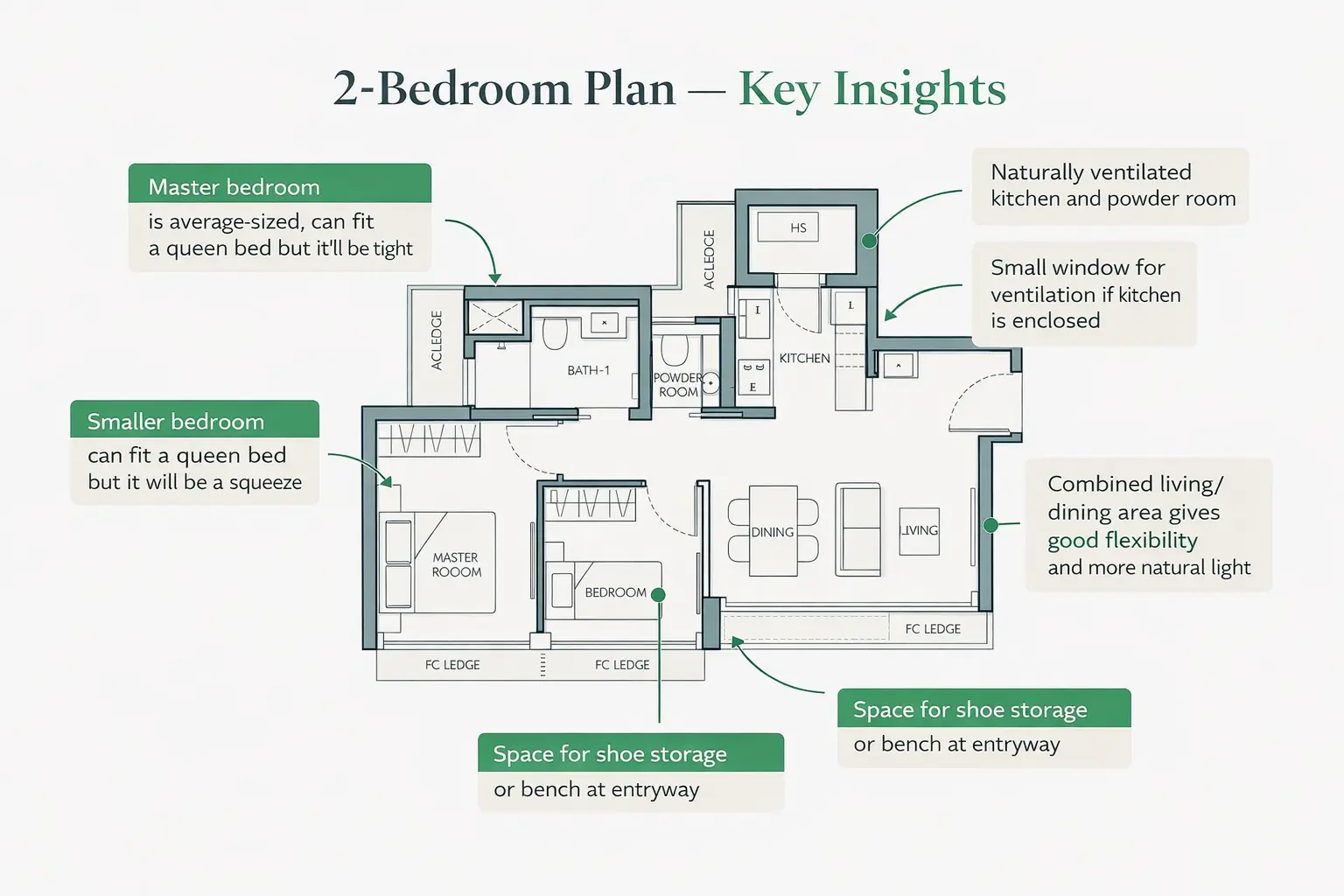
With home prices on the rise, many buyers in Singapore are starting to accept a 2 bedroom condo layout as a realistic option, especially for smaller families and couples. That said, not all two-bedders work the same way. Older units can look generous on paper but waste space through awkward planning, while some newer layouts still fall short in everyday practicality, even with GFA harmonisation in place.
At Property Launcher, we often see buyers focus too much on unit size without fully considering how the space is actually used. A good layout isn’t just about square footage, it’s about how comfortably you can live in it. Below are some key points to keep in mind when assessing what makes a well-designed two-bedroom condo in Singapore.
1. Avoid wasteful planter boxes and bay windows
This issue is most commonly found in older resale condos, particularly those launched before GFA harmonisation was introduced in 2023. In the past, developers were allowed to include elements such as planter boxes, bay windows, air-con ledges, and strata void spaces in the total saleable area. While this boosted the stated unit size, it often resulted in less usable living space.
By 2026, buyers are far more aware of this problem but it still matters, especially when comparing resale units against newer launches. In a 2 bedroom condo layout, wasted space has a much bigger impact, as these units already operate within tighter size constraints.
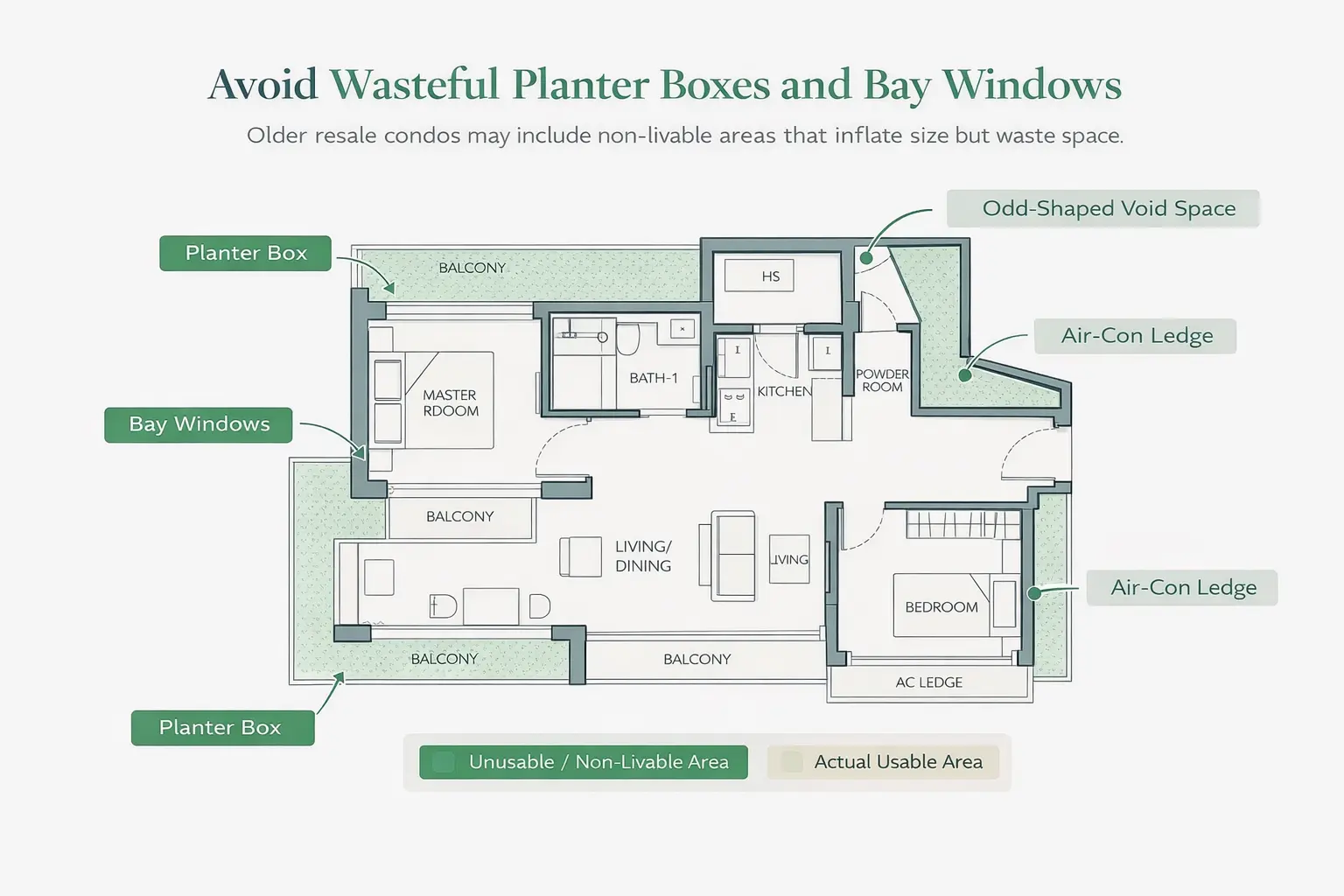
These features are usually easy to spot on a floor plan. Look out for planter boxes within balcony areas, ledges drawn along windows, or oddly shaped corners that don’t serve any functional purpose.
Another important consideration is how these spaces can distort price-per-square-foot (psf) comparisons. For example, a $1.6 million two-bedder that measures 800 sq. ft. on paper (including non-liveable areas) may appear cheaper at around $1,940 psf. A similar unit without these features might be listed as 700 sq. ft., pushing its psf to roughly $2,325.
In reality, both units could offer the same amount of actual liveable space, and the one with the higher psf may even represent better value. This is why, in 2026, savvy buyers focus less on headline size and more on how efficiently a two-bedroom layout is planned and used.
2. Don’t assume a “+1 study” automatically adds value
A “+1 study” is often marketed as a flexible solution for buyers who need extra space but can’t stretch to a three-bedroom unit. In practice, however, its usefulness varies widely depending on how the space is designed.
For a study to work well, it needs to feel like a room rather than leftover space. Buyers should look for adequate width, proper ventilation, and the option to enclose the area without making it uncomfortable. A study that relies solely on borrowed light or sits awkwardly along a walkway is unlikely to function well as a home office, nursery, or guest room.
Equally important is what the layout sacrifices to create this additional space. In some cases, the study is achieved by shrinking the kitchen or forcing an open layout that limits storage and countertop space. For households that cook regularly, this trade-off can affect daily living far more than an extra room label suggests.
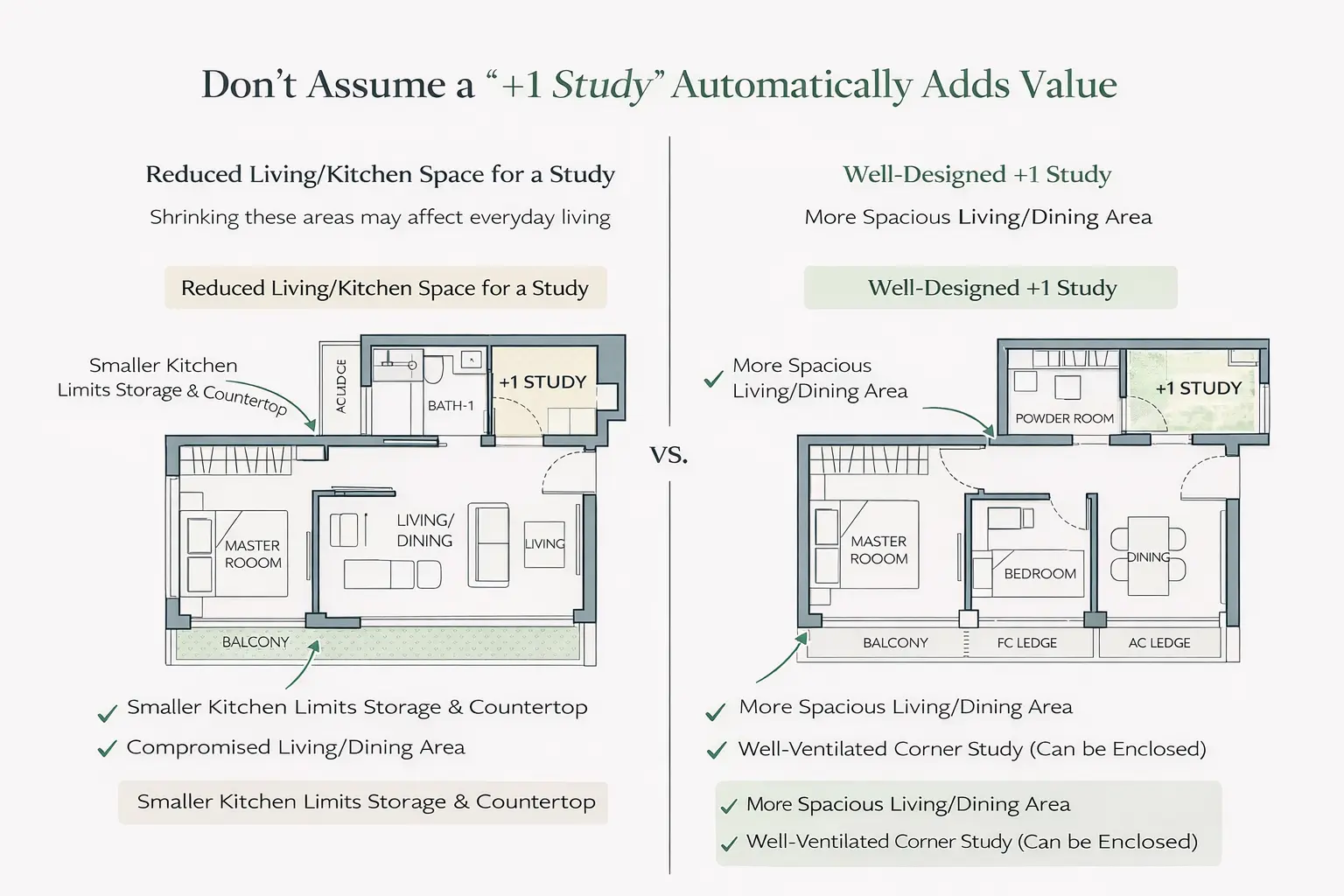
Ultimately, a well-designed two-bedroom layout should feel balanced. If the “+1” comes at the cost of core living spaces, buyers may be better off choosing a cleaner, more efficient layout instead.
3. Kitchen layout should prioritise function, not just appearance
In a 2 bedroom condo layout, kitchen design is often where space is sacrificed first. While open kitchens may look modern, they can be impractical for daily use, especially for households that cook often.
A more usable layout allows for sufficient cabinetry and counter space, ideally on both sides, rather than a single-wall setup that quickly feels cramped. Buyers should also check whether the kitchen can be enclosed later, as cooking smells and grease can easily spread into the living area in an unenclosed layout.
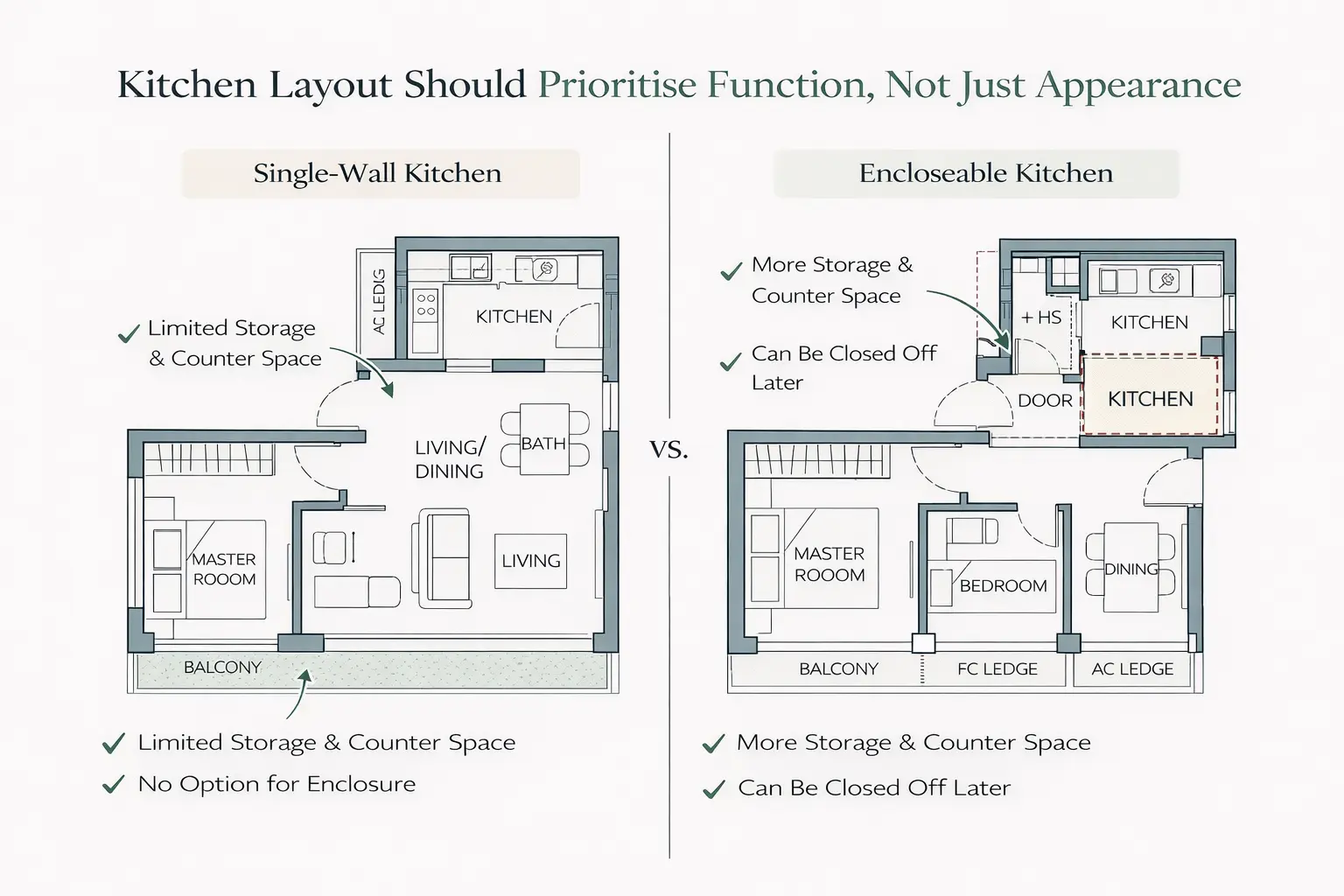
Kitchen placement matters too. Layouts where the kitchen is neatly contained are generally easier to adapt and live with, compared to kitchens that protrude into the living or dining space. From a rental perspective, a functional kitchen also appeals to a wider range of tenants, particularly families and long-term renters.
4. Bedrooms should be sized for real use, not just on paper
In a 2 bedroom condo layout, both bedrooms should be large enough to function properly, not just meet minimum measurements. A practical benchmark is whether each room can comfortably fit a queen-sized bed while still allowing space to move around and place basic furniture.
Developers often signal this by showing a queen bed in the floor plan. When a bedroom is left blank or appears tightly drawn, it’s worth checking the actual dimensions rather than relying on assumptions. A room that technically fits a bed but offers little circulation can quickly feel cramped in daily living.
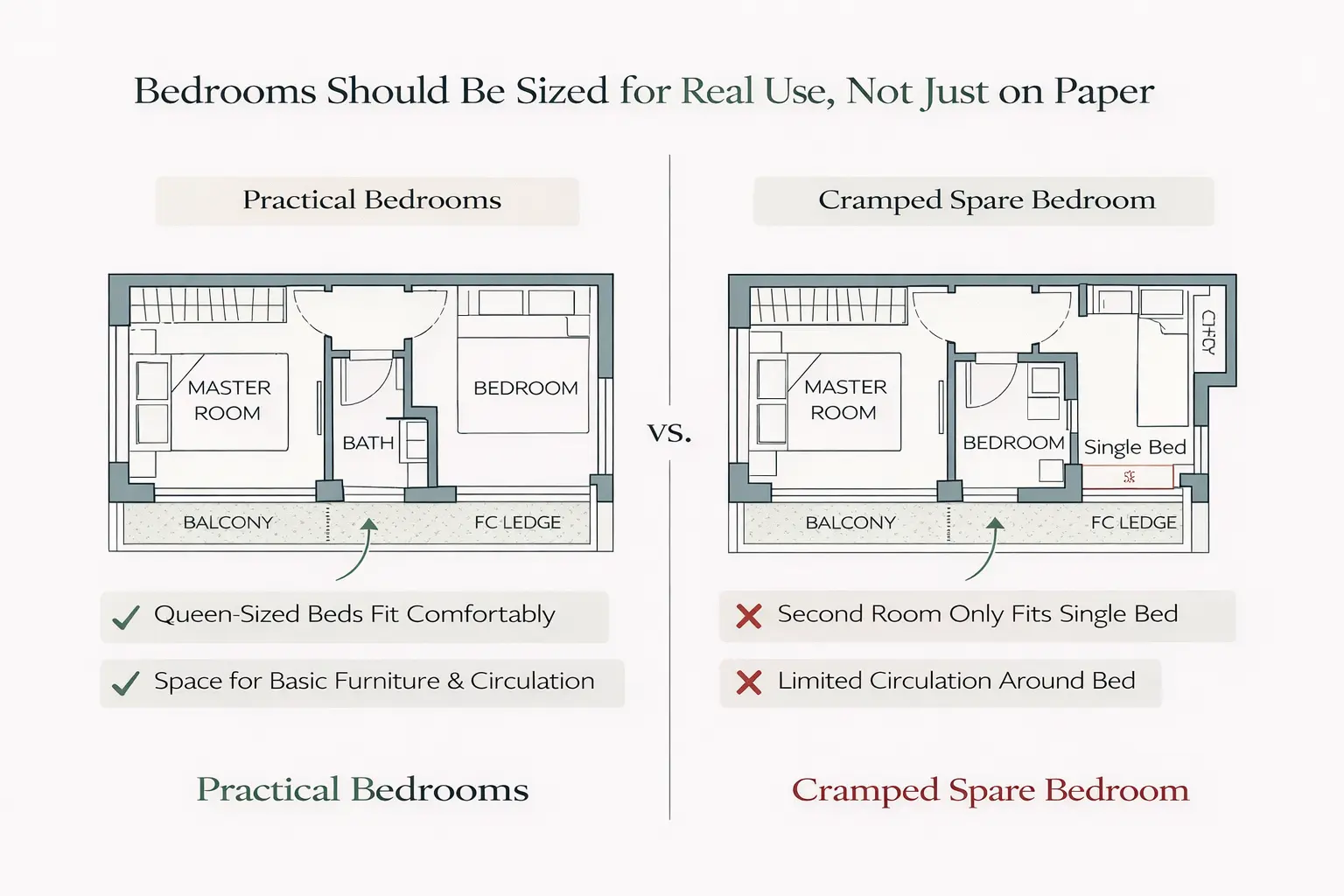
Although many two-bedroom units fall within a similar size range, bedroom proportions can vary widely. Some layouts heavily favour the master bedroom, leaving the second room only suitable for a single bed. This imbalance can reduce flexibility for families and make rental arrangements less straightforward, especially when both rooms are meant to serve similar purposes.
5. A second bathroom doesn’t automatically improve the layout
In a 2 bedroom condo layout, the presence of two bathrooms is often treated as a clear advantage, but this isn’t always the case. Its value depends heavily on how the space is used and who the unit is meant for.
Some buyers prefer to allocate more space to bedrooms or living areas rather than accommodate an additional bathroom. In compact layouts, the extra bathroom can come at the cost of comfort elsewhere, making the home feel tighter overall.
For rental use, however, a second bathroom may carry more weight. Tenants—especially those sharing the unit—often place higher value on having separate bathrooms. In contrast, singles who opt for a two-bedroom unit mainly for flexibility or workspace may see little practical benefit from an extra bathroom.
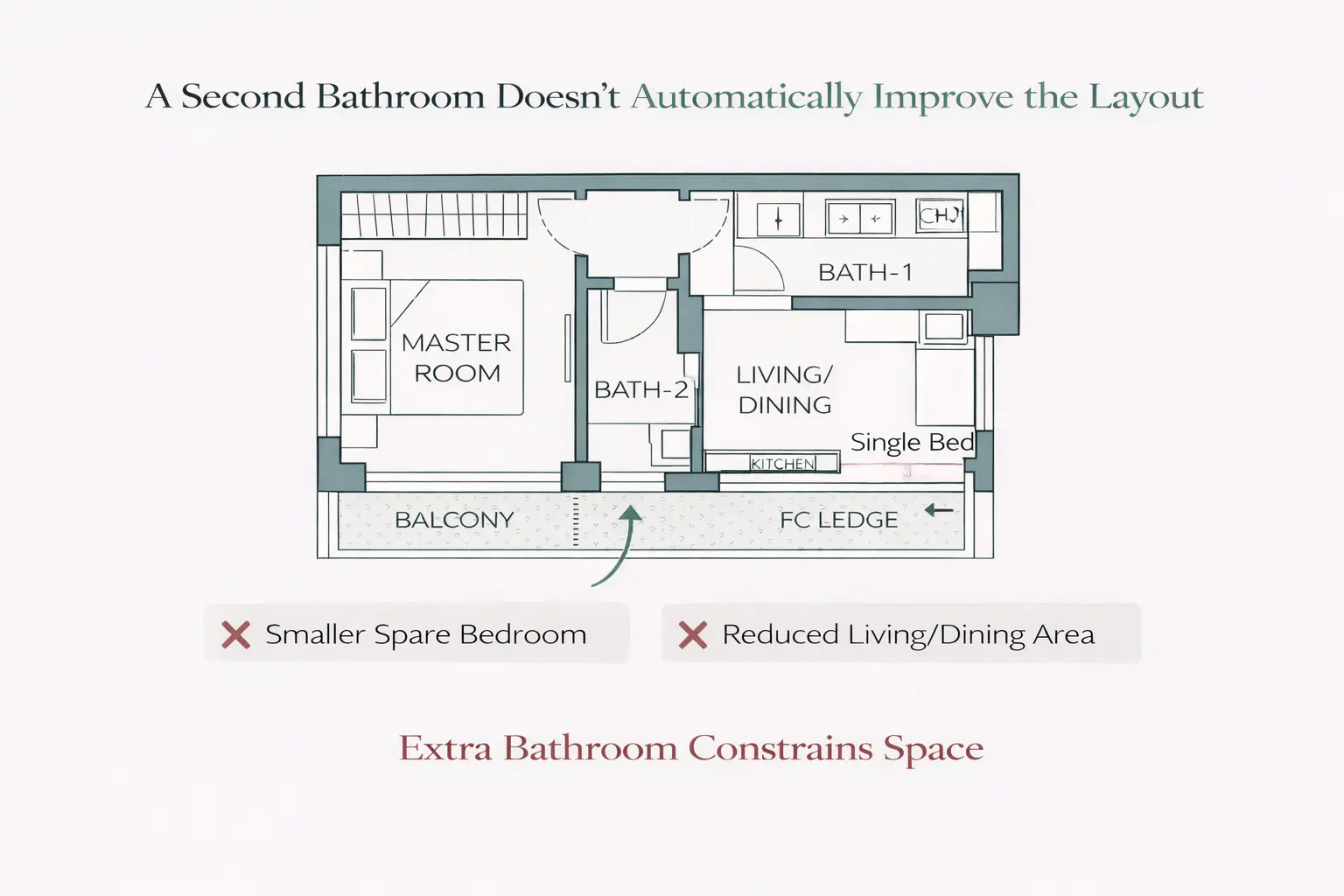
The key is to assess whether the second bathroom aligns with the intended use of the unit, instead of assuming it makes the layout superior by default.
6. The dining area should work for everyday use and small gatherings
In a 2 bedroom condo layout, the dining space is often treated as an afterthought. In some designs, it is so compressed that it functions more like an extension of the living area, offering little separation or comfort. When this happens, residents may end up eating in the kitchen simply because there isn’t enough usable space.
A more considered layout allows the dining area to seat at least four people without overwhelming the living room. This creates a clearer distinction between spaces and makes meals feel more intentional. If the dining table is positioned directly in front of the television with no buffer, the area is likely too tight.
While two-bedroom units aren’t designed for large-scale entertaining, they should still accommodate small gatherings comfortably. Whether it’s a family meal or a casual get-together with friends, the dining space should not feel restrictive.
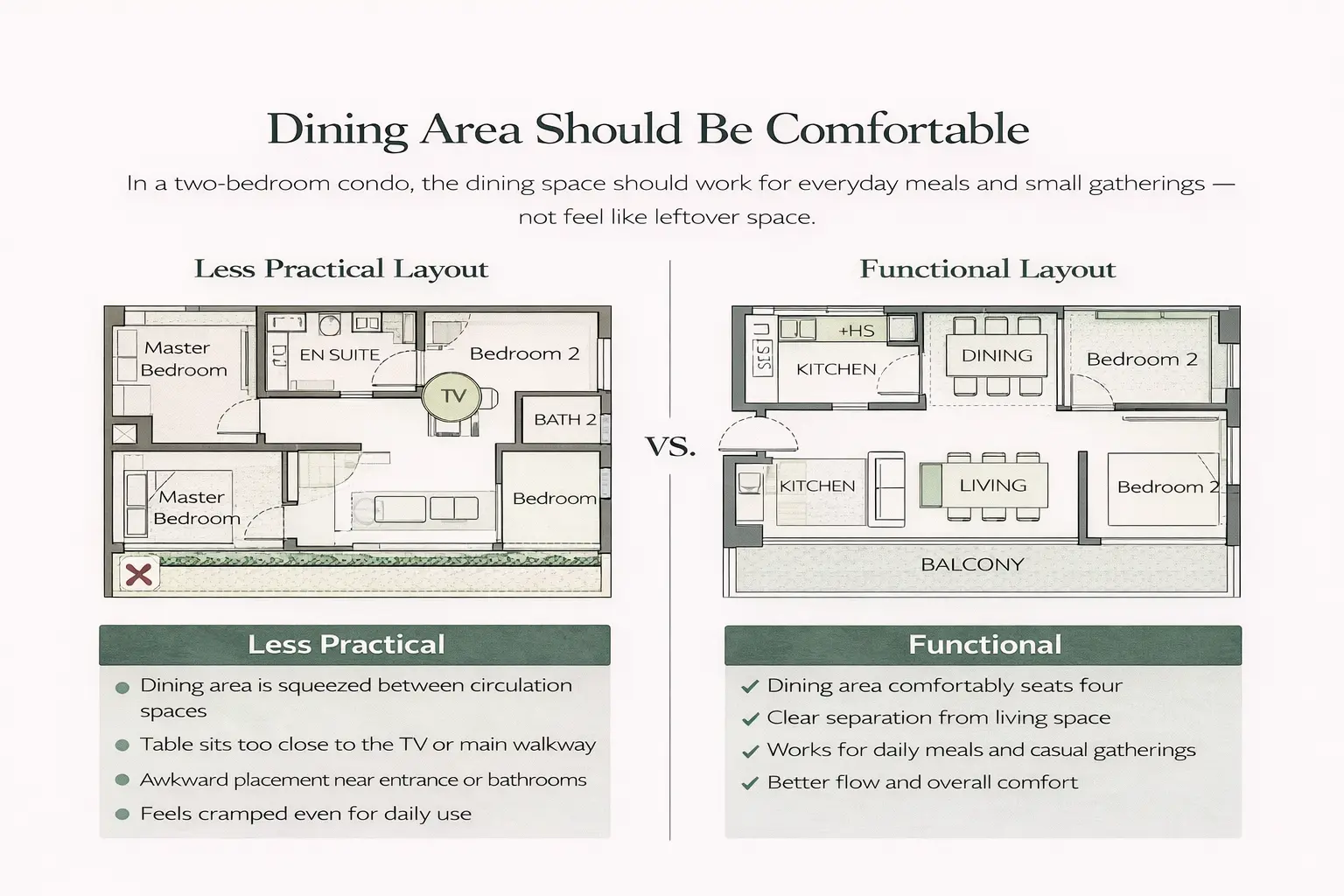
It’s also worth paying attention to placement. Dining areas that sit directly next to the main entrance or too close to bathrooms can feel awkward and reduce overall comfort, even if the dimensions appear adequate on paper.
7. Efficient layouts can eliminate the need for corridors
In a 2 bedroom condo layout, corridors are not always necessary. Layouts where bedrooms are positioned on opposite sides of the living and dining area often use space more efficiently, as they reduce transitional areas that don’t serve a clear function. Removing corridors also allows more natural light and airflow to reach the centre of the unit, making the home feel brighter and less enclosed.
Some buyers may be hesitant about layouts where the main entrance opens directly into the living space, particularly from a privacy or Feng Shui perspective. This can usually be addressed with simple design solutions, such as a partial divider or a low cabinet near the entrance, which helps create separation without reintroducing wasted space.
8. Pay attention to ventilation in the kitchen and bathrooms
In a 2 bedroom condo layout, airflow becomes especially important because of the compact internal space. The kitchen and bathrooms are usually where ventilation issues show up first. If the kitchen is enclosed or designed as a nook, it should have a proper ventilation window or yard to allow heat, smoke, and cooking smells to escape. Without this, the space can become uncomfortable very quickly, particularly for households that cook often.
Bathrooms deserve the same level of scrutiny. Relying on a small window or minimal ventilation can lead to lingering odours and moisture problems, which are more noticeable in smaller units. This is even more important in layouts with only one bathroom, where poor ventilation affects daily use. Good airflow in these areas makes a noticeable difference to comfort and hygiene over time.
Watch out for awkwardly shaped spaces
Rounded walls and wedge-shaped layouts are more commonly found in older developments and often create practical challenges in everyday living. While curved walls may offer wider views in some cases, they tend to limit furniture placement and reduce usable wall space. The larger surface area can also trap more heat, affecting comfort over time.
Similarly, triangular or wedge-shaped rooms may look interesting on a floor plan but are usually inefficient in practice. As the space narrows, it becomes harder to furnish properly, often requiring custom carpentry or design work to make the room functional. This adds cost and reduces flexibility, especially in smaller units where space is already tight.
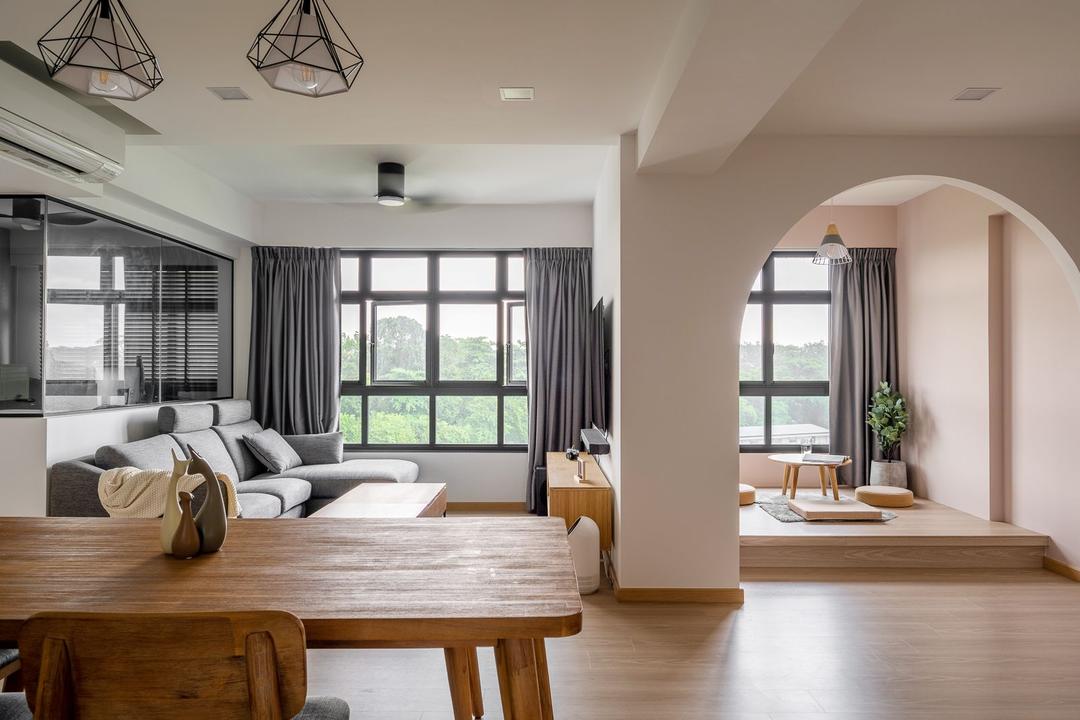
At Property Launcher, we focus less on headline features and more on how layouts perform in real day-to-day use. Clean, regular-shaped spaces are generally easier to live in, furnish, and adapt over time, making them a more practical choice for buyers exploring new launch properties in Singapore.
 Discover Singapore’s latest launches in CCR, RCR, OCR and EC—complete with live price lists, PSF ranges, floor plans and daily refreshes.
Join The Discussion